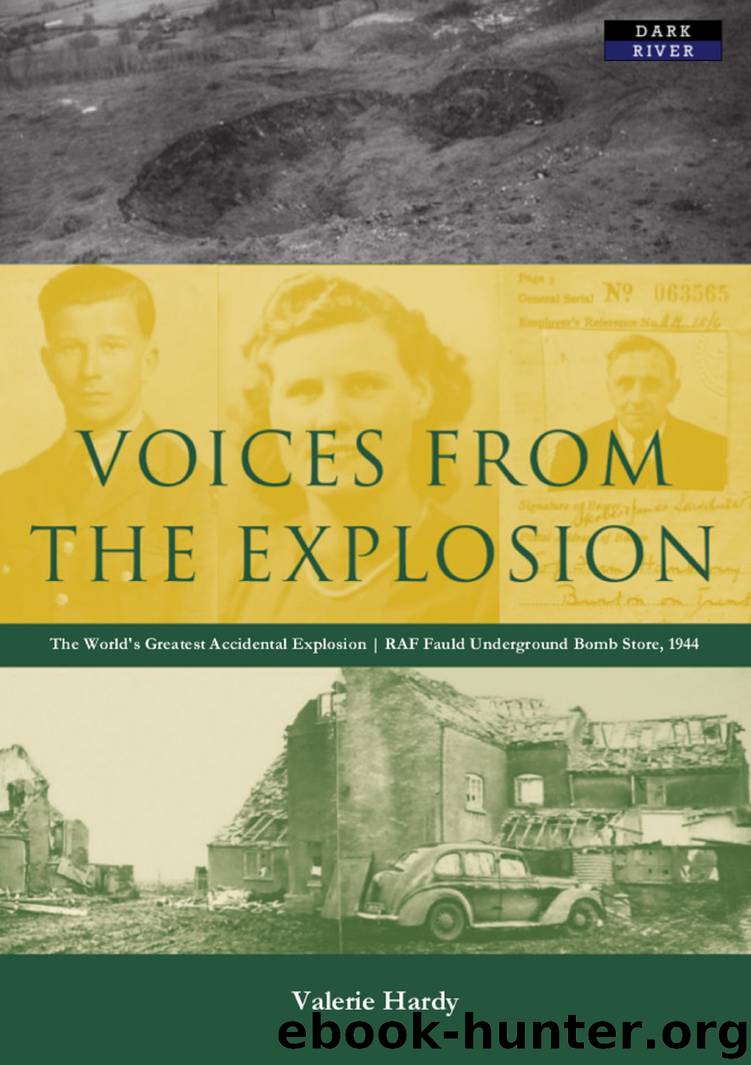
Voices from the Explosion by Valerie Hardy
Author:Valerie Hardy [Hardy, Valerie]
Language: eng
Format: epub
Tags: History
Publisher: Bennion Kearny
Published: 2015-07-23T16:00:00+00:00
Reverend James Crook 1943. Taken from a photo loaned by Bill Moore
Damage to St Werburgh’s Church and Mrs Bowen’s cottage opposite. Photo courtesy of the Magic Attic archive
The Vicar’s search for casualties took him to Hanbury Fields Farm and he then arranged for the School and the Parish Room to be used as a mortuary.
By this time the rescue parties and fire parties arrived from all over and I went back to the school to clear it ready for the reception of casualties.
The police were wonderful and so were the R.A.F. personnel and the Americans. One cannot speak too highly of them. The women of the village also gave us wonderful help.18
The Vicar worked unstintingly during the hours and days and weeks that followed. He personally visited all of the bereaved. John Cooper recalls that it was about eleven o’clock that night that the vicar knocked on the door and said:
“I’m afraid Joe won’t be coming home tonight.”
Shortly after the explosion, twenty-one-year-old John Hardwick and his father of Top Farm, Hanbury walked up to the village to see what assistance they could render. He has written:
On our way we passed cottages where there were widows who as yet did not realise it. Their husbands were at work in the alabaster mine adjacent to the dump and many of them had been killed in the workings.
Then I began to walk up the village and met one lady leaning over her gate. I could see from her face that she suspected the worst, for her husband was in the mine. He was dead and they had seven children under twelve. She [Rose Bowring, see Chapter Four] still lives in the village.
The road to the village was strewn with debris. What few telephone lines we had in those days were down. Structural damage towards the village was greater and one cottage was damaged beyond repair. [This was the Harrisons’ home.] It was eventually taken down and for thirty years its only memorial was a laburnum tree which survived in what had once been the garden.
Our concern was for the men in the mine and we made our way down Featherbed Lane towards an air shaft for the mine which should have provided an escape route for the gypsum miners.
At the end of Featherbed Lane, the “Hut”, our village hall, which was in a 1914–18 war creosoted long shed with slow combustion stoves, was just a pile of timbers. In it we had had all of our village functions. We had celebrated the Coronation [of George VI]. Now it was gone – piano keys littered the path and a pot-cupboard had been blown yards away, but the pots survived.
As we went towards the air shaft we passed what had been a 60 acre farm [Hanbury Fields, also known as Moat Farm], this was now in ruins. A three-bay Dutch barn, full of valuable winter fodder (wartime) was on fire and it didn’t seem to matter. At that point I clearly remember about us winning the war – and it didn’t seem to matter.
Download
This site does not store any files on its server. We only index and link to content provided by other sites. Please contact the content providers to delete copyright contents if any and email us, we'll remove relevant links or contents immediately.
| Africa | Americas |
| Arctic & Antarctica | Asia |
| Australia & Oceania | Europe |
| Middle East | Russia |
| United States | World |
| Ancient Civilizations | Military |
| Historical Study & Educational Resources |
Room 212 by Kate Stewart(5119)
The Crown by Robert Lacey(4814)
Endurance: Shackleton's Incredible Voyage by Alfred Lansing(4780)
The Iron Duke by The Iron Duke(4354)
The Rape of Nanking by Iris Chang(4211)
Joan of Arc by Mary Gordon(4109)
Killing England by Bill O'Reilly(4001)
Say Nothing by Patrick Radden Keefe(3984)
I'll Give You the Sun by Jandy Nelson(3446)
Shadow of Night by Deborah Harkness(3367)
Hitler's Monsters by Eric Kurlander(3341)
Mary, Queen of Scots, and the Murder of Lord Darnley by Alison Weir(3210)
Blood and Sand by Alex Von Tunzelmann(3203)
Eleanor & Park by Rainbow Rowell(3171)
Darkest Hour by Anthony McCarten(3129)
Margaret Thatcher: The Autobiography by Thatcher Margaret(3081)
Book of Life by Deborah Harkness(2938)
Red Famine: Stalin's War on Ukraine by Anne Applebaum(2932)
The One Memory of Flora Banks by Emily Barr(2863)
